Reliability Services
On-Site Maintenance and Reliability Services
Our
Field Service Technicians are experienced in a wide variety of rotating equipment and associated technologies to perform maintenance necessary Increase Uptime, Reduce Downtime, and Maximize Equipment Reliability.
Services include setting up and running preventive and predictive maintenance programs to performing corrective actions such as balancing or alignment. EMX has the experience to keep your plant up and running. Our Field Service personnel are
OSHA/MSHA trained for safe work practices.
ON-SITE PREVENTIVE AND PROACTIVE MAINTENANCE SERVICES
- Vibration Testing and Analysis
- Laser Shaft and Pulley Alignment
- DC Motor Brush & Commutator Wear Maintenance
- Motor Condition Inspections
- Lubrication and Greasing Programs
- Electric Motor and Equipment Cleaning
- On-Site Fan and Blower Balancing
- On-Site Rotor Balancing
- Electric Motor Testing and Analysis Including ALL-TEST Pro Professional
- Rotating Equipment Diagnostics
- Infrared Thermography-Thermal Imaging
- Babbitt Bearing Inspections and Repairs
- Inverter/AC Drive Repairs, Installation & Commissioning Services
- Lubrication Management/Tribology
- Remote Condition Monitoring
- Re-packing Pumps
- Seal Replacement and Repairs
- On-Site Maintenance
Implementing a reliability maintenance plan will impact your bottom line by reducing motor system failures and the resulting costly downtime.
The goal of our EMX Equipment Reliability Service is to diagnose potential problems before failure occurs
Motor & Generator Maintenance
Motor & Generator Maintenance Services
Without proper maintenance, critical motors and generators can be prone to erratic reliability and unexpected failure.
The best approach to safeguard your Motor or Generator and ensure it will perform when you need it most is to engage in routine predictive and preventive maintenance.
Electomechanex's motor and generator service provides expertly trained technicians who can identify and resolve issues before they turn into expensive problems. Because many motors and generators do not display symptoms of impending failure, it is essential to detect issues as early as possible.
Properly maintaining your motors and generators ensures that they will run smoother for a longer period of time, reducing the risk of costly downtime and lowering overall total cost of ownership.
If requesting emergency service, please
submit form and call (856)362-4553 to verify availability.
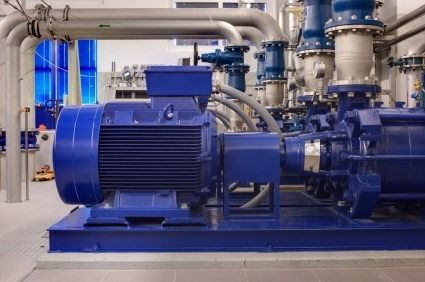
As with all repair services, Electromechanex offers turnkey service including; removal, repair, installation, thermal imaging, laser shaft alignment, vibration-anlaysis, and machine start-up and testing.
Winding Testing
Winding Testing & Analysis
Motor Winding Analysis is an ideal method for detecting winding issues and to monitor the dielectric strength of your winding insulation. This method is a necessary aspect of any electric motor preventative maintenance. This program can be used to troubleshoot or eliminate the motor windings as the source of a failure. It can also be used as a trending tool so we can monitor the dielectric strength of your winding insulation over a period of time. With motor winding analysis, our skilled technicians can discover early-stage problems inside electrical equipment before they become more substantial. This early detection method allows us to perform the appropriate repairs during planned downtime; in addition to reducing repair costs during unscheduled shutdowns, motor winding analysis can lessen costs associated with catastrophic component failure. Motor winding analysis is a form of non-destructive testing (NDT) that can be used for motor, transformer, and generator windings.
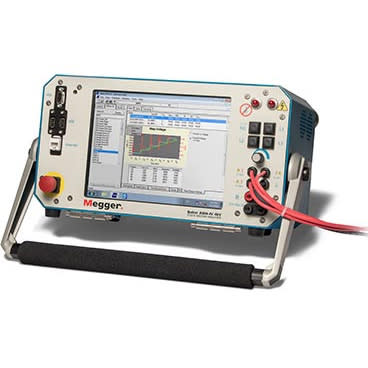
At Electromechanex, we utilize the most state-of-the-art equipment for our motor winding analyses. Motor Winding Analysis (MWA) involves three equally important motor winding insulation tests to establish the condition of your motor winding insulation. This information will help in reducing motor failure that results in costly downtime, lost production, safety hazards and increased maintenance costs.
ALL-TEST PRO 7™ PROFESSIONAL
We can test any motor’s resistance, stator, rotor, contamination and insulation stats all on one device and receive accurate diagnostics within as little as a few minutes.
In addition to the core functionalities of the ALL-TEST PRO 7™, the ALL-TEST PRO 7™ PROFESSIONAL has additional functionalities that test DC Motor types, Traction motors and Transformers, and utilizes route based testing for data trending and analysis.
Testing for:
- Offline testing of AC and DC Motors, Transformers, and Generators
- Testing installation and startup of new motors
- Condition monitoring
- Troubleshooting
Trouble Identified:
- Stator Issues
- Rotor Issues
- Ground Faults
- Winding Faults
- Open Connection Issues
- Contamination Issues
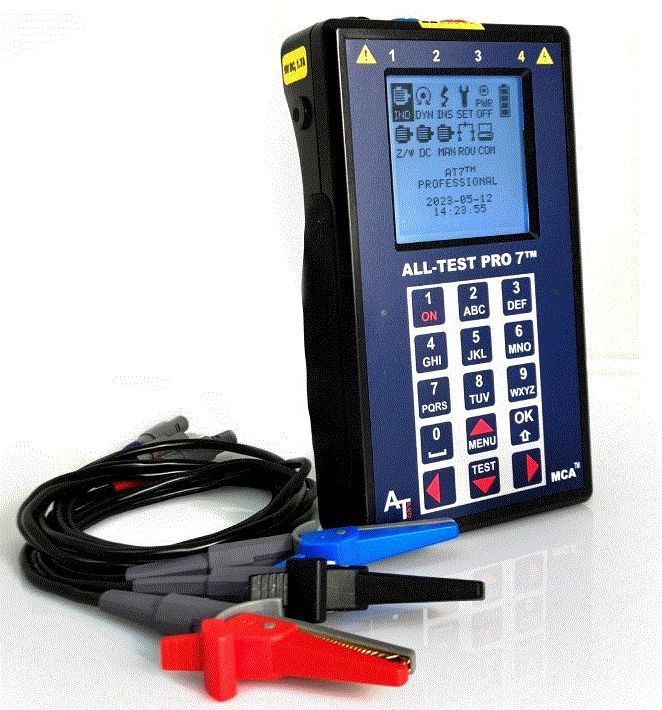
- Off-line testing:, All-Test Pro 7 Professional which uses de-enerized Motor Circuit Analysis (MCA) Testing Instrument
- Off-line testing:, SKF Advanced Winding Analyzer (AWA-IV) which uses DC voltage. Any detected leakage is viewed in micro-amps.
- Off-line testing:, which uses a 1-Minute Megger Test, Hipot Test, and Surge Test.
- On-line testing: which measure amps and voltage per phase and Rotor Bar tests.
If you can’t make it into our shop, don’t worry—our testing equipment can be quickly brought to you in the field.
If requesting emergency service, please submit form and call (856)362-4553 to verify availability.
Infrared Thermography
Infrared Thermograghy
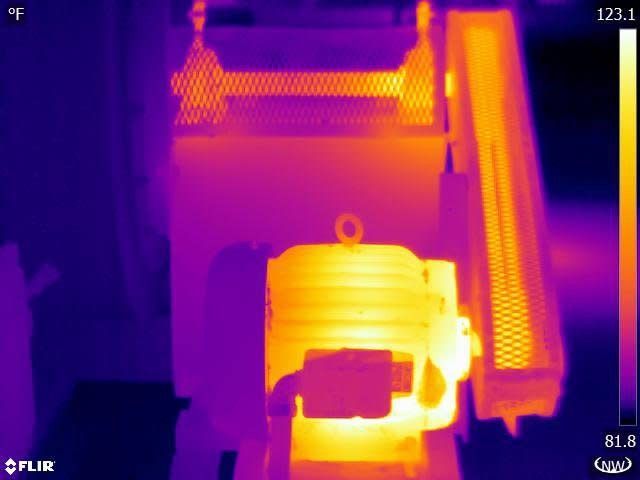
Inspecting mechanical equipment using infrared thermography is a big advantage in a condition based monitoring program.
Infrared technology is a cost-effective way to find failing components, bad connections, and load imbalances. Knowing ahead of time that there will be a problem means repairs can be made on a regular basis instead of when an emergency occurs. Infrared thermography is the process of using a thermal imager to detect radiation (heat) coming from an object, converting it to temperature and displaying an image of the temperature distribution.
Images of the detected temperature distribution, called thermograms, make it possible to see heat-producing objects invisible to the naked eye.
The primary goal of infrared thermography is to confirm machinery is running normally and to detect abnormal heat patterns within a machine, indicating inefficiency and defects.
When regularly scheduled, these inspections can bring early discovery of equipment failures.
Remote Condition Monitoring
Remote Condition Monitoring uses internet-based technology in the form of sensors and platforms, etc., to gather data and relay the information to wherever it is needed. Remote condition monitoring (RCM) automatically tells service teams when installed equipment is not operating to specification or needs attention. Knowing how deployed sensor (vibration, temperature etc.) are performing in real time, service can be scheduled based on the equipment’s needs, rather than on the calendar, and even before the customer knows there is an issue. This information enables our service and engineering teams to understand the use and performance of the equipment being monitored in the field. Machines experiencing functionality issues can be diagnosed by experienced technicians through remote monitoring industrial solutions.
Repair and maintenance tasks, such as recommending the changing of a bearing,
balancing a fan, or performing
an alignment, can also be monitored and managed remotely