
Vibration Testing & Analysis
Vibration-Analysis
At some time during a motor’s life, it is likely to experience high vibration levels. What’s behind this maintenance phenomenon? The cause may be an electromagnetic or mechanical imbalance, loose components, rubbing parts, bearing failure, or resonance.
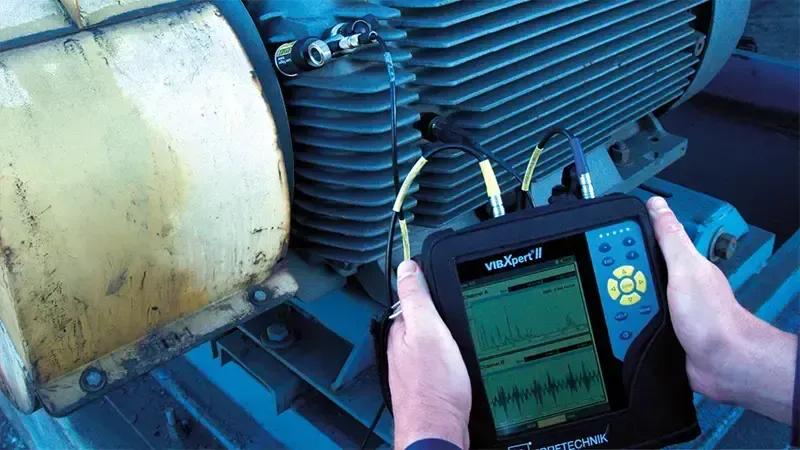
When a problem occurs, it is critical to quickly identify the source and take corrective action. Using EMX’ latest vibration analysis diagnostic techniques can save you money and downtime. EMX’ uses VibePro 7.3.5 which is a portable device, route-based instrument used for collecting vibration data on rotating machinery. It reduces collection,analysis and reporting time, compared with similar devices. This allows EMX to determine the severity of the stress level of bearing or gear wear on your motor. The data is recorded from each machine and uploaded on the software, providing quick recognition of change in the vibration pattern, as an indicator of deterioration. Corrective actions are then taken.
Benefits:
Vibration in rotating machinery is commonly the result of mechanical faults including mass unbalance, coupling misalignment, loose components, and many other causes. Improving the levels of vibration should always include elimination of the source of vibration and not addressing the symptom by making balance corrections. Mass unbalance will produce vibration due to the force generated by the eccentric weight. This force will be imposed at the running speed of the shaft, and depends on the amount eccentric mass the eccentricity of the weight , and the frequency of rotation . In more common terms the unbalance is defined by the eccentric weight, mounting radius, and shaft speed.
The observed vibration signature will show elevated amplitudes at 1xRPM and no other significant frequencies when rotor unbalanced is the main fault. Unfortunately, other common faults can also generate high levels of vibration at 1xRPM including coupling misalignment, looseness, rotor bows, and a variety of other sources. In some cases, these faults will produce other symptoms that can suggest corrections other than balancing should be done. Yet in many cases, balancing may be the chosen course of action for lowering vibration amplitudes even though it is not the source of vibration. Once it is determined that balance corrections should be made, the balancing process includes measuring reference vibration, adding trial weights, observing the response due to trial weights, and using the response characteristics to determine the location of balance correction weights to reduce vibration to an acceptable level.
Vibration analysis and trending is a method of evaluating current machine condition and monitoring a machine’s changes over a period of time. It can also be used to pinpoint a source of several problems such as misalignment, imbalance and bearing issues. Vibration Trending and Analysis can be performed on all rotating equipment.
Benefits of Vibration Trending & Analysis
- Diagnose imbalance & misalignment
- Discover bearing issues
- Applicable on any rotating equipment
- Improve equipment reliability and uptime
- Prevent catastrophic failure
- Improve machine safety levels
Applications for Vibration Trending & Analysis
- Motors
- Pumps
- Air handlers
- Fans
- Gearboxes
- Machines